Lighting a Small Urban Garden: 7 Space-Saving Ideas
Seven compact lighting strategies for courtyards and small city gardens, using vertical accents,...

The garden at midday is a different place from the garden at nine in the evening. One is a set of borders, paths and chairs; the other is somewhere you might actually settle for two hours with a drink and a plate of something. Decorative lighting is what bridges the two, and it asks surprisingly little of you. A few lanterns, a run of string lights and one well-placed fire bowl will do most of the work — provided you put them where they serve a purpose rather than scattering them wherever there happens to be a spare branch.
The most common mistake is buying one kind of light and spreading it thinly across the whole plot. Twenty small stakes along the border edge produce an even, flat glow that flatters nothing and helps nobody find the corkscrew after dark.
Garden lighting works better in three layers. Ambient light gives the background a soft wash — a hedge uplight, a string of bulbs under the pergola, a couple of solar lanterns on the shed. Task light puts a pool of brightness exactly where hands go: the dining table, the step by the back door, the shelf beside the barbecue. Accent light is the smallest layer and the most charming: a single lantern on the potting bench, a fire bowl throwing moving shadows up a wall, a small spotlight grazing a tree trunk.
If you only ever do one thing, make it this: choose two or three points in the garden that you can see from the kitchen window and light those properly. The rest can follow over a season.
Lanterns are the flexible part of the scheme. Unlike almost everything else in a garden, they can be moved in ten seconds when the plan changes — when the table shifts under the apple tree, when guests arrive at dusk and the path needs marking, when the power goes off.
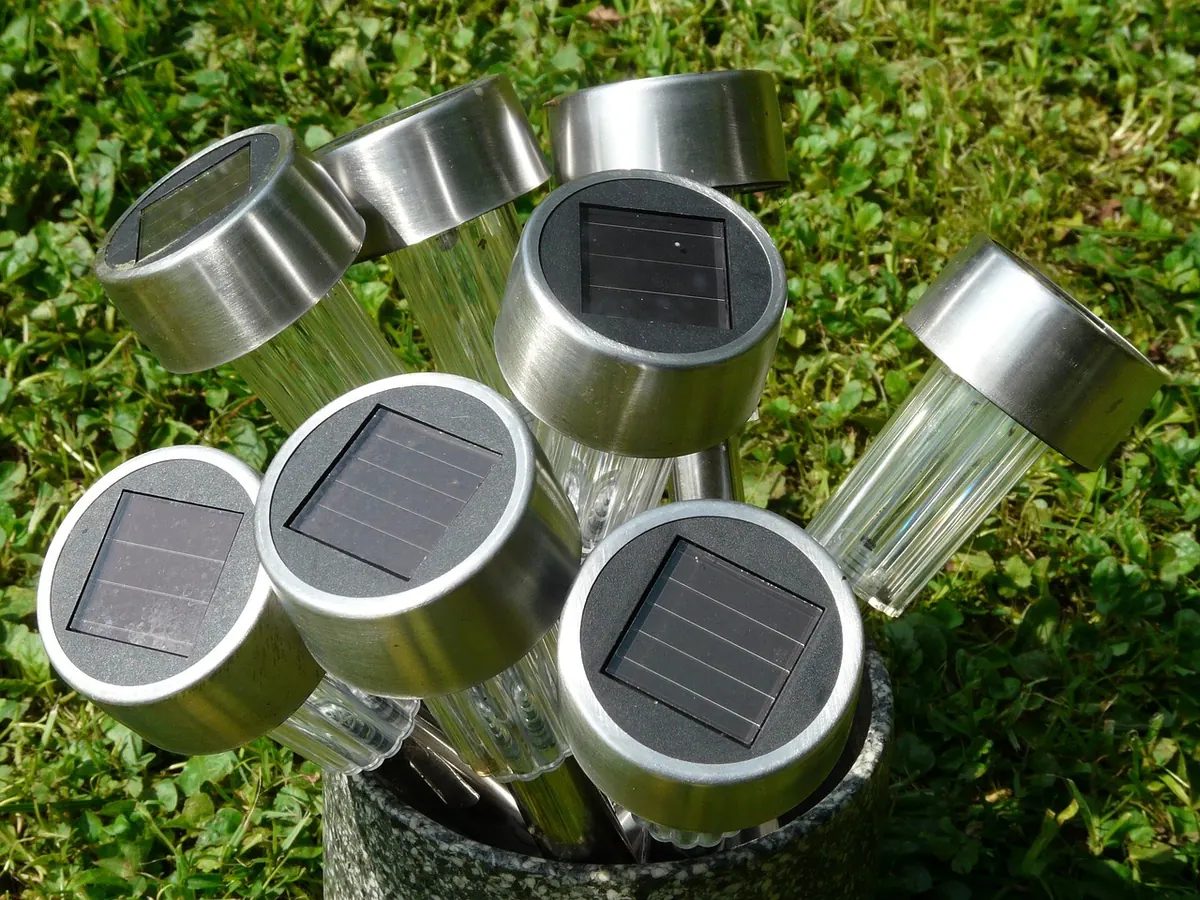
Glass and metal lanterns with a candle inside are hard to beat for atmosphere, but they are fussy in a breeze and demand attention. Battery and rechargeable LED lanterns have improved enormously and now give a convincing warm glow; they also let you leave a lantern on a step overnight without worrying. Solar versions are fine in full sun but disappointing in shade or in a grey week, so use them where they will genuinely charge.
Whatever the type, keep weight in mind. A tall lantern on a windy terrace needs a wide base or a bit of sand in the bottom; nothing ends an evening faster than a crash from the far end of the patio.
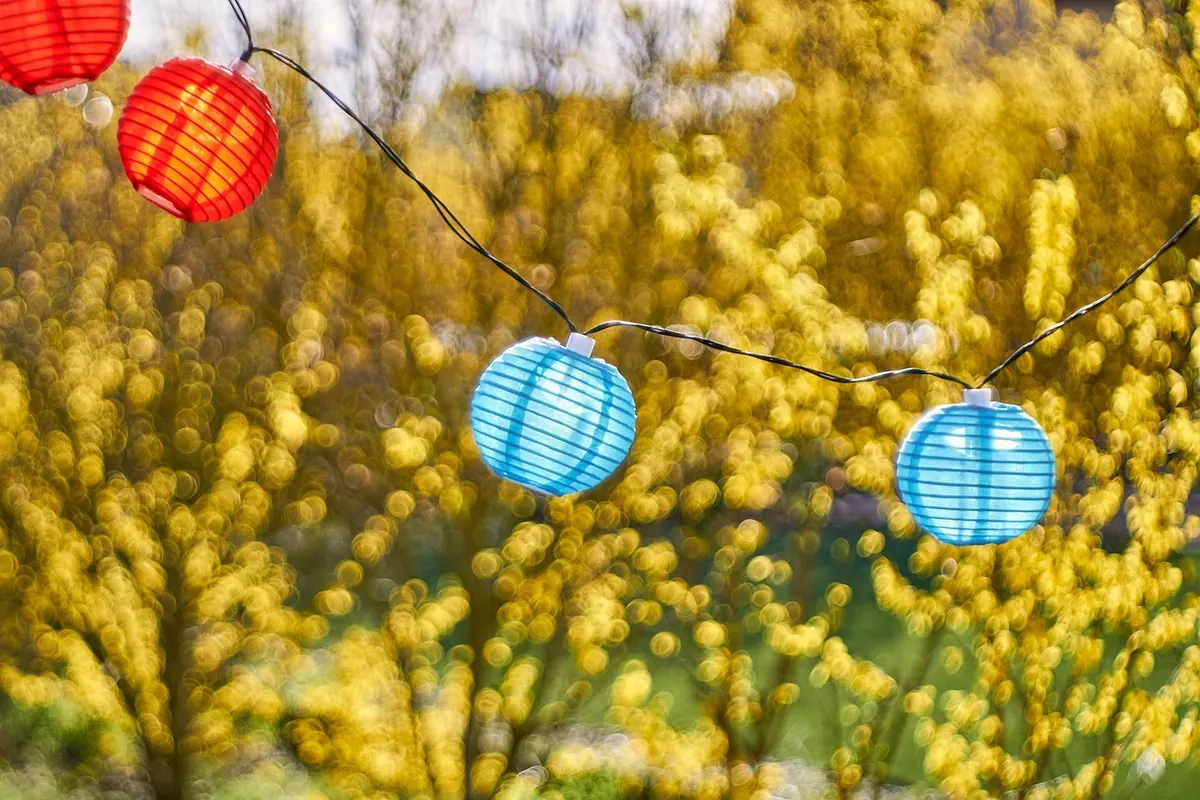
Festoon lights — the round, rubber-cased bulbs on a thick cable — are the most forgiving decorative light you can buy. They span awkward gaps, they tolerate rain, and their bulbs sit far enough apart to look relaxed rather than frantic.
Run them between two fixed posts, a pergola beam and a wall bracket, or from the house to a mature tree. The single biggest improvement most gardens could make is simply raising them: hang festoons at roughly 2.3 to 2.5 metres over a walking route so nobody's head brushes the cable, and let them dip slightly between supports. A shallow catenary curve looks natural; a dead-straight line pulled tight looks like a washing line.
Colour temperature matters more than bulb count. Warm white in the region of 2700K suits brick, timber and foliage; cool white turns leaves grey and makes skin look tired. Avoid wrapping trunks tightly — cables and ties can bite into bark as a tree grows — and keep any cable clear of a fire bowl, a hot grill or a path where someone might catch a foot.
Smaller wire lights have their place, but be selective. Draped loosely through a shrub, they suggest fireflies; wound densely around a fence panel, they read as a fairground. If you want a calmer look, choose a string with fewer bulbs spaced further apart and switch off every second length if your set allows it.
A fire bowl does something no bulb can: it gives off heat, and heat is what keeps people outside in September. It also gives you a natural centre for seating, which is worth thinking about before you buy one.
Place it on a stable, non-flammable surface — stone, gravel, concrete — well away from fences, overhanging branches, wooden furniture and anything that might blow across the patio. Allow a generous clear circle around it, and check local rules on open fires and smoke before you rely on one through the summer; some areas restrict them, and neighbours on a still evening will notice.
Fuel choice shapes the experience. Wood gives crackle, smoke and the smell people remember, but it demands attention and a place to store logs. Gas is instant and clean, with adjustable flames, though it gives less of a fire to watch. Gel and ethanol burners sit happily on a table for a small, controlled flame. Whichever you choose, keep a lid or screen for when the evening ends, and never leave a live fire unattended.
A fire bowl is brightest at its base, so put the light that matters for conversation at eye level elsewhere. Two lanterns on a low table beside the seating, or a string of bulbs overhead, will do more for faces than a taller flame.
Use equipment rated for outdoor use, keep connections off the ground and out of puddles, and have fixed wiring installed properly rather than improvised — an electrician is worth the call for anything more involved than plugging in a festoon set. A timer or smart plug saves you from remembering, and lets the garden be lit when you come home. Rechargeable lanterns and solar pieces should come indoors for winter; cables last far longer when they are coiled loosely and stored dry.
And keep the light low-level where you can. Brightness is not the goal. Being able to see your friends' faces, find the path and stay out an hour longer is.
Start on a Friday evening with what you already own. Move the lanterns you have to the table, hang one string of lights overhead, and light a fire if you have a bowl. Sit outside for an hour and notice where the light fails you — a dark step, a black corner, a bulb in your eyeline.
On Saturday, fix only those three things. Add a second short string if the span is too long, shift the lantern off the sightline, put a small light at the step. By Sunday night you will have a garden that works after dark, built from three simple elements and adjusted to the way you actually use the space.
Photo: distelAPPArath / Pixabay
Seven compact lighting strategies for courtyards and small city gardens, using vertical accents,...
Practical ways to conceal garden lights, transformers and cable runs using planting, mulch and edging — so...
Solar and low-voltage garden lights differ most in wiring, upfront cost, and how steady they stay through...