
Garden Decor Lighting Ideas: Lanterns, String Lights, and Fire Bowls
A practical guide to lanterns, string lights and fire bowls: how to layer decorative garden lighting for...

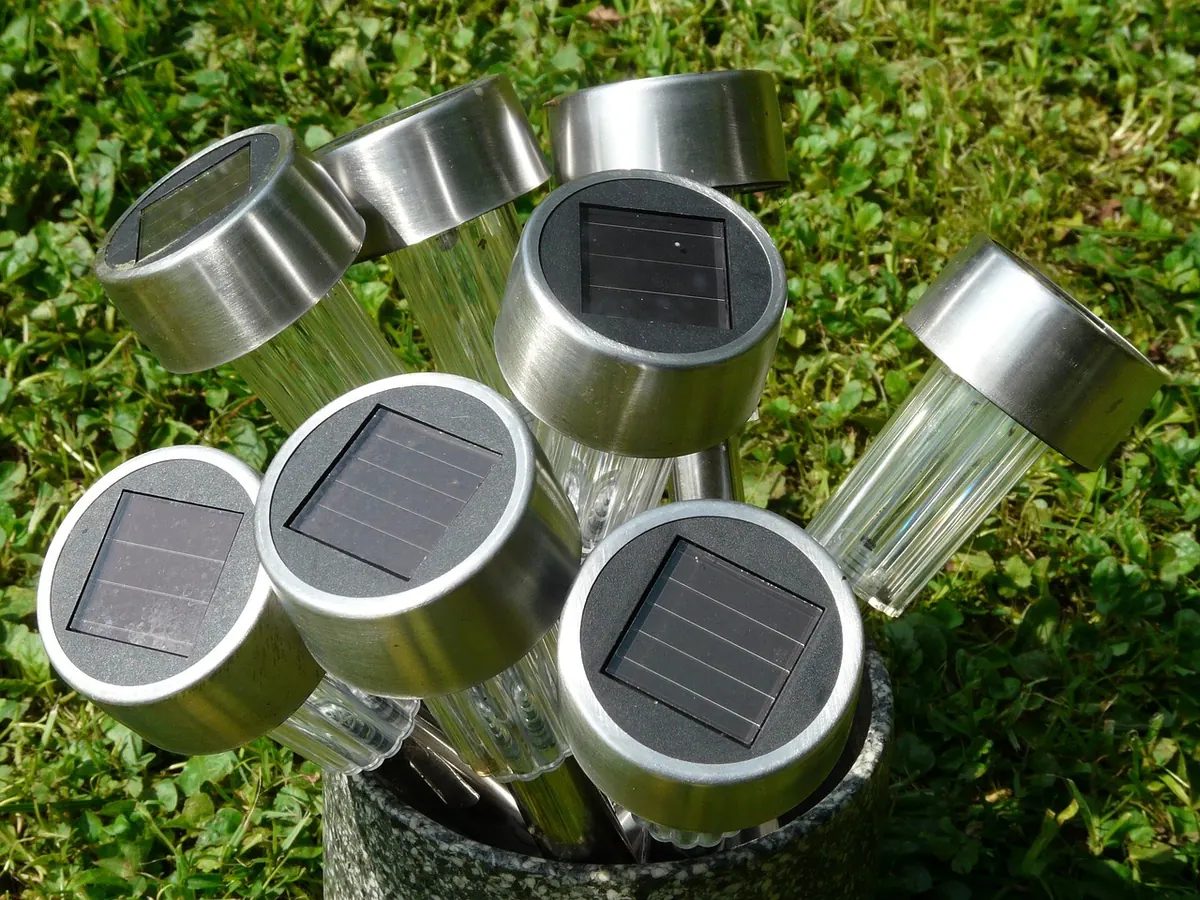
A path edged with soft pools of light is one of the least expensive ways to make a garden feel finished. Then you start shopping, and the choice splits in two: fixtures that plug into a transformer, or fixtures that carry their own little solar panel. Both light a border. Both look good in a photo. The difference shows up in week three, when the evenings get shorter and one system quietly keeps its promise while the other starts to fade by nine o'clock.
Here is what actually separates them, from the money you spend on day one to the evenings you spend tightening connectors in the rain.
A low-voltage system takes 120-volt household power, steps it down to 12 volts through a transformer, and sends it along a buried cable to each fixture. Because the voltage is low, the cable is thin and safe to handle with the power on. The catch is voltage drop: over a long run, the fixtures at the far end receive less power than the ones near the transformer and glow dimmer. Good design accounts for this by using heavier-gauge cable on long runs or splitting the garden into two circuits.
Solar fixtures skip the wiring entirely. Each unit has a photovoltaic panel, a small battery, and a controller. The panel charges the battery during the day and the controller releases that charge after dusk. Nothing connects to your house. Whatever power a fixture collects is the power it has to spend that night, which is why placement matters more than any specification on the box.
Comparing sticker prices is misleading, because the two systems bundle different things. A solar bollard includes its own panel, battery, controller, and LED, so the price you see is close to the price you pay. A low-voltage fixture is only the fixture. The transformer, the cable, the cable connectors, and the stakes are separate line items, and together they often cost as much as the lights themselves.
As a rough shape rather than a quote: entry-level solar is the cheapest way to light a path, and a well-built low-voltage system is usually the larger investment for a comparable number of fixtures. The gap narrows when you price quality solar with replaceable batteries against a modest low-voltage kit. It widens again if your garden is large, since solar cost scales with the number of fixtures while low-voltage cost scales mostly with cable runs and transformer capacity.
Low-voltage installation is straightforward but physical. You lay out the fixtures, run cable between them, and bury it a few inches deep where nobody will dig. Under a lawn you will want it deeper, and under a paving edge it may need protection. Leave a little slack at each fixture so you can reposition later, and keep every connection above ground or in a proper waterproof enclosure. Water in a connector is the single most common reason a low-voltage system develops a dead spot.
Solar installation is a placement puzzle. Each panel needs several hours of direct sun, and "shade in the afternoon" is enough to cost you an evening of light. Watch your garden at different times of day before committing, and remember that a bed which is sunny in April may be under a leaf canopy by July. If a fixture has a separate panel on a cable, you get the freedom to put light where you want it and the panel where the sun is — a small feature that solves a lot of frustrating sites.
If wiring a new outdoor circuit or adding an outlet means working on household mains, that is a job for a licensed electrician. The 12-volt side you can usually handle yourself.
This is where low-voltage earns its keep. A transformer delivers consistent current, so a 12-volt fixture produces the same brightness in December as it did in June. That steadiness matters for uplighting a tree, washing a wall, or lighting steps where uneven output is a safety issue rather than a mood choice. Dimming, timers, and smart controls are widely available and behave predictably.
Solar output is a moving target. A good fixture on a good day is genuinely pleasant; the same fixture after three overcast days will be noticeably dimmer. Brightness also tails off through the night as the battery drains, which is fine for ambience and less fine for a step you need to see at midnight. Modern panels and lithium cells have narrowed the gap considerably, but no solar light can outrun a lack of sun.
Cold shortens battery capacity and thick cloud cuts charging, so solar systems work hardest exactly when the garden needs light most. Frost on a panel, snow cover, or a fixture tucked under an eave can leave it dark for days. The fix is mostly planning: oversize your panel relative to the light, keep panels clear, and accept that a few weeks a year will be dim.
Low-voltage systems shrug off winter as long as the connections stay dry and the transformer breathes. Their weak points are mechanical: a cable nicked by a spade, a connector that fills with water, a transformer mounted where snow sits against it. All three are preventable and cheap to fix when they happen.
Neither system is maintenance-free, but the work is different in character. Solar is a routine of small checks; low-voltage is mostly a case of leaving things alone and intervening when something fails.
Reach for low-voltage if you need dependable brightness, have shade to work around, want to light trees or walls rather than just edges, or plan to expand the system later. Reach for solar if running cable is impractical — a rented patio, a rented flat, a gravel border you would rather not dig — or if the lights are decorative and a dim week now and then is acceptable.
A mixed garden often works best. Use low-voltage for the fixtures that must always be on: steps, a main path, a specimen tree. Use solar for the far corner, the shed, and the borders where you want glow rather than illumination. Start with four or five fixtures in the places you actually walk after dark, live with them for a month, and add more once you know where the light belongs.
Photo: Hans / Pixabay
A practical guide to lanterns, string lights and fire bowls: how to layer decorative garden lighting for...
Seven compact lighting strategies for courtyards and small city gardens, using vertical accents,...
Practical ways to conceal garden lights, transformers and cable runs using planting, mulch and edging — so...